
Echoes Beneath the Amazon — Cueva de Los Tayos Remote Viewing Debrief & What Recent Reality Tells Us
Remote Viewing, Archaeology, and the Thin Line Between Symbol and Stone
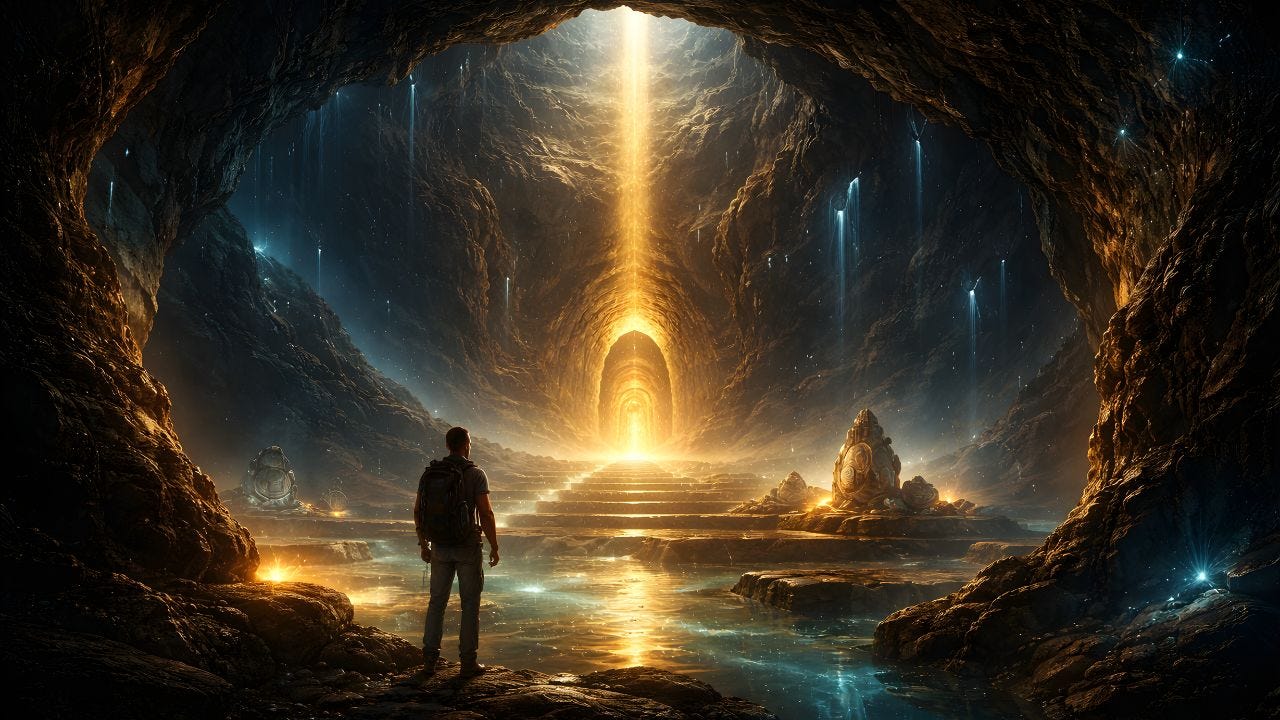
Originally Published on FFG’s Private Site, March 2022 — Now Released with Updated Context & Analysis
Cueva de Los Tayos — hidden deep in Ecuador’s Morona-Santiago rainforest — has stood at the crossroads of myth, science, indigenous wisdom, and speculative exploration for nearly a century.
Named for the nocturnal oilbirds (Steatornis caripensis) that navigate its chambers by echolocation, this vast limestone cave system has captivated explorers with tales of hidden chambers, enigmatic structures, and possibility itself.
Today we revisit our March 2022 remote viewing session, where viewers reported:
Structured subterranean corridors with shifted geometry that felt “purposeful, not random.”
An internal “portal-like” energy zone that suggested cultural or ritual significance.
Perceptual impressions of symbolic marks and light patterns that appeared non-random and encoded.
These descriptions — evocative and layered with archetypal imagery — are striking.
But how do they hold up when viewed against the latest real-world evidence and ongoing research?
Where Modern Exploration Aligns — and Where It Diverges
1. The Cave’s Naturality vs. Apparent Geometry
Scientific explorations and geological mapping confirm that Cueva de Los Tayos is a natural limestone karst system, with over 4.6 km of passages mapped to date — making it the longest known cave in Ecuador.
Geologists maintain the tunnels and chambers were formed by water erosion over millions of years, not by artificial construction.
Remote Viewing vs. Geological Check:
While the remote viewing described corridors with “purposeful angles,” modern research shows these shapes are natural. Still, the session may have been detecting something else: how the cave feels to humans. Not engineered design, but psychological and symbolic weight — the sense that this is a place of meaning, ritual, or threshold.
2. “Portal Zones” in Remote Perception — Scientific Echoes
Remote viewers sensed zones of transition or threshold energy deep in the cave’s depths. Interestingly, archaeologists have documented areas of historical significance — including burial sites and ritual deposits dating back millennia.
And indigenous Shuar traditions regard parts of the cave as spiritually charged spaces, invoking ritual and cosmological significance passed down through generations.
Remote Viewing Touchpoint:
Our session may have converged on zones of human-sacred engagement — unquestionably real within cultural and historical contexts — even if not “portals” in a literal sense.
3. Artifacts, Metal Libraries & Mythic Claims
Longstanding legends — from Juan Moricz’s mid-20th-century claims of metal libraries to Erich von Däniken’s extraterrestrial narratives — suggested extraordinary artifacts within the cave.
Current evidence does not support the existence of golden books, alien inscribed plates, or lost libraries. Multiple expeditions have concluded that such claims lack credible archaeological support.
Remote Viewing Reflection:
When interpreted metaphorically or archetypally, the remote data may reflect collective myth narratives or unconscious symbolic frameworks — not physical repositories of unknown technology or hidden civilizations.
The session nevertheless produced data that was relevant to the original tasking and consistent with the general characteristics of the site. Its more specific claims, however, remain unverified and should be regarded as provisional.
So What Is Real — and What Still Matters?
Cueva de Los Tayos is real — geologically, ecologically, and culturally. It’s among the most profound subterranean ecosystems in South America, home to unique fauna, complex cave systems that reflect millions of years of carving by water, and deep Shuar cultural significance.
The cave continues to draw renewed public and scientific interest:
Ongoing explorations map previously unknown chambers.
Indigenous narratives affirm ancestral reverence and ritual engagement.
Cultural myths persist, even as conventional archaeology rejects pseudoscientific artifacts like “metal libraries.”
Remote viewing — when interpreted with nuance and guarded against literal overreach — can function as a cultural-psycho-spiritual lens into places where history, myth, and lived human experience intertwine.
FFG Exclusive — Full Debrief
Final Thought
Mystery isn’t the absence of facts — it’s the space between perception and meaning. Cueva de Los Tayos remains a focus of real exploration: geological, cultural, ecological — and, for those inclined, perceptual. The interplay between what is and what we sense continues to shape our understanding of places that defy easy categorization.
📩 Subscribe to FFG Intelligence
Where remote perception meets disciplined analysis — and myth is treated as data, not doctrine.

Future Forecasting Group is comprised of the best non-military remote viewing team in the world, with decades of experience and a track record to match.
Disclaimer
This publication is for informational and educational purposes only. Remote viewing data is inherently speculative and should not be interpreted as fact, proof, or actionable advice. Future Forecasting Group does not guarantee the accuracy, outcome, or implications of any remote viewing content. Readers are encouraged to apply critical thinking and conduct independent research.
never heard of this one before; fascinating. Both can be true -natural caves used for special purposes- and the evidence of underground civilizations is impossible to ignore...